
← Research

Wireless-Aided Robotic Navigation

Robots that localize radio sources and navigate with wireless signals, from probabilistic RF localization to a 10-GHz robotic testbed.

Wireless signals carry rich spatial information in their multipath, and a robot can use them to find a radio source and navigate toward it, even when cameras and maps are incomplete. But a single RF measurement is usually ambiguous: blockage and reflections leave several plausible source locations.

We treat this as probabilistic inference: learn full belief maps over where a transmitter could be, use those beliefs to guide a robot’s search, and validate everything on a 10-GHz robotic testbed in the upper mid-band (FR3).

Full project details on Haozhe Lei’s site →

Finding the Invisible: Wireless Source Localization. H. Lei, R. Chen, Y. Jiang, A. Dhananjay, S. Rangan. View on LinkedIn
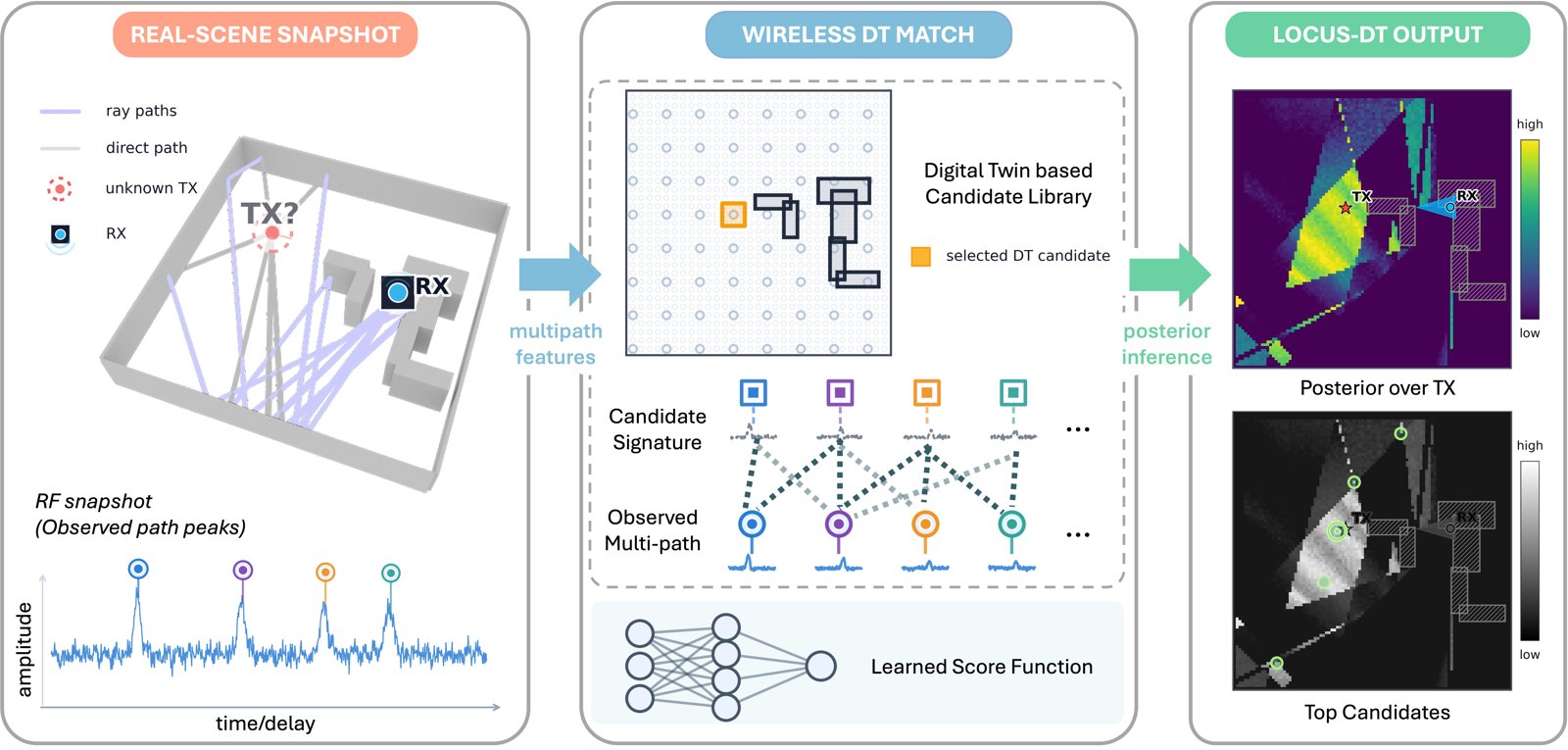
LOCUS-DT: a measured RF snapshot is matched against ray-traced digital-twin candidates to produce a posterior over transmitter location
Research area 1

Probabilistic source localization

Rather than forcing an ambiguous RF snapshot into one coordinate, we learn full posterior distributions over transmitter location, preserving directional and multimodal uncertainty. Our methods match measured multipath against ray-traced wireless digital twins, learn measurement-conditioned likelihoods, jointly infer position and heading, and keep working when the robot has mapped only part of its environment.
  • LOCUS-DTDigital-twin posterior localization
  • MC-CLELearned full-posterior likelihoods
  • MAGNETARJoint position & heading inference
  • MAPLE-RFLocalization with partial maps
Animation of a robot's camera view and predicted map as a wireless-guided navigation policy searches an indoor environment
Research area 2

Wireless-aided navigation

Belief maps become guidance for a robot's search policy. Using ray-traced digital twins as a physics-informed prior, our reinforcement-learning agents navigate unseen indoor environments toward a transmitter zero-shot, with the robot's SLAM system supplying the map and pose.

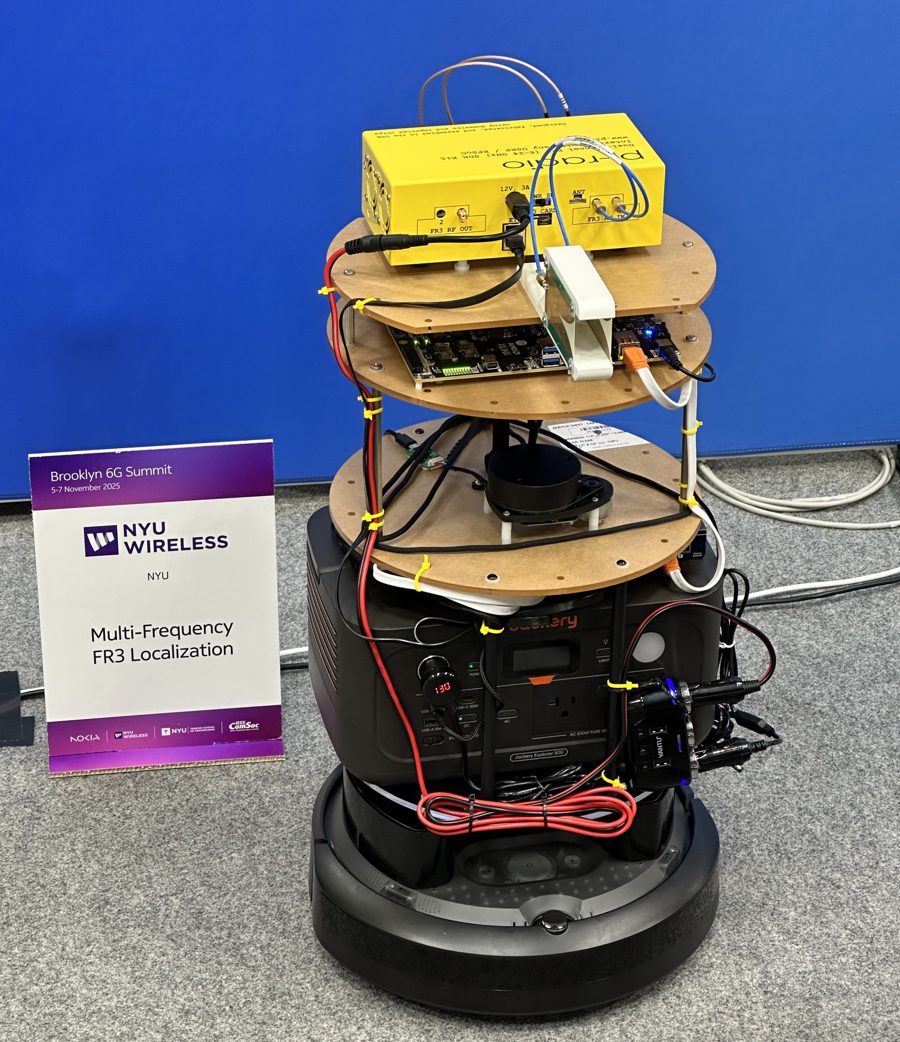
The MobiFR3 robot, a TurtleBot4 carrying a Pi-Radio FR3 transceiver, at the Brooklyn 6G Summit 2025
Research area 3

Robotic experimental platform

MobiFR3 is our 10-GHz robotic RF testbed. It pairs Pi-Radio SDR channel sounding and Vivaldi antennas with TurtleBot4 / ROS 2 robots, LiDAR, odometry, and RGB sensing, so every RF measurement is tied to a precise robot pose. Measurement-aligned Sionna RT scenes calibrate simulation to the hardware, connecting simulation-trained models to physical experiments.

Figures and video courtesy of Haozhe Lei.

Publications

  1. H. Lei, R. Bomfin, M. Chafii, S. Rangan, LOCUS-DT: Localization via Observation-Conditioned Uncertainty Scoring with Digital Twins, arXiv preprint, 2026.
  2. H. Lei, H. Guo, T. Svensson, S. Rangan, Beyond Point Estimates: Likelihood-Based Full-Posterior Wireless Localization, Asilomar Conference on Signals, Systems, and Computers, 2026.
  3. H. Lei, R. Chen, Y. Jiang, A. Rasteh, A. Dhananjay, S. Rangan, MAGNETAR: Multipath-Guided Spatial Posteriors for Transmitter Pose Inference in the Upper Mid-Band, arXiv preprint, 2026.
  4. H. Lei, S. Rangan, MAPLE-RF: Efficient Probabilistic RF Source Localization in Partially Explored Environments, arXiv preprint, 2026.
  5. T. Li, H. Lei, H. Guo, M. Yin, Y. Hu, Q. Zhu, S. Rangan, Digital Twin-Enhanced Wireless Indoor Navigation: Achieving Efficient Environment Sensing With Zero-Shot Reinforcement Learning, IEEE Open Journal of the Communications Society, 2025. arXiv
  6. M. Yin, T. Li, H. Lei, Y. Hu, S. Rangan, Q. Zhu, Zero-Shot Wireless Indoor Navigation through Physics-Informed Reinforcement Learning, IEEE ICRA, 2024.

People

  • Haozhe Lei (lead), Ruibin Chen, Yuhan Jiang
  • Collaborator: Aditya Dhananjay