What Happens to a Product That Does Not Fit
Multiply two 8-bit numbers and the answer needs 16 bits. That is not a corner case — it is always true. So when a design multiplies two 8-bit values and stores the result in 8 bits, something is thrown away every time, and the whole question is what.
int_prod.sv computes one product and reports it four different ways at once,
so the four answers can be compared side by side.
The module
module int_prod #(
    parameter int W = 8
) (
    input  logic signed [W-1:0]   a,
    input  logic signed [W-1:0]   b,
    output logic signed [2*W-1:0] prod,        // full product — nothing lost
    output logic        [W-1:0]   hi,          // upper half, as bits
    output logic        [W-1:0]   lo,          // lower half, as bits
    output logic signed [W-1:0]   trunc,       // what "a*b" gives you in W bits
    output logic signed [W-1:0]   sat,         // clamped instead of wrapped
    output logic                  overflow,    // did trunc lose the value?
    output logic                  hi_nonzero   // the WRONG test — see -1 * 1
);
Note there is no clk and no rst. This is pure combinational logic: outputs
follow inputs after a propagation delay and nothing is remembered. It is also
perfectly synthesizable — this would become real gates on a device.
The same expression, twice, with different answers
These two lines are the heart of the demo:
    prod  = a * b;          // LHS is 2W bits -> operands widen -> exact
    trunc = a * b;          // LHS is  W bits -> the multiply happens in W bits -> wraps
Identical text. Different results.
SystemVerilog sizes an arithmetic expression to fit its destination, not
just its operands. Because prod is 16 bits wide, a and b are widened to
16 bits first and the multiply is exact. Because trunc is 8 bits wide, the
whole multiply is carried out in 8 bits and anything above bit 7 is simply
discarded.
This rule is one of the most common sources of surprise in SystemVerilog. It is worth reading those two lines until they stop looking like a typo.
Truncation, or saturation
Discarding the top half is not the only option. Saturation clamps the value to the largest magnitude that does fit:
    if (prod > SAT_MAX)
        sat = SAT_MAX;
    else if (prod < SAT_MIN)
        sat = SAT_MIN;
    else
        sat = prod;         // it fits, so this truncation loses nothing
That last branch is worth a moment. It truncates too — prod is 16 bits and
sat is 8 — but only after the if has established that the value fits.
Truncation is safe exactly when you have already proved it is unnecessary.
Reading a part-select
    hi = prod[2*W-1:W];
    lo = prod[W-1:0];
A part-select in SystemVerilog is always unsigned, whatever the thing you
sliced was declared as. hi and lo are views of the bits of prod, not
numbers in their own right, and they are declared logic [W-1:0] — without
signed — to say so. This comes back in samp_pack, where
it causes a real bug.
Detecting overflow, and getting it wrong
The honest test asks the obvious question — is the 8-bit answer the true answer?
overflow = (prod != trunc);
Both are signed, so trunc sign-extends to 16 bits before the comparison and
this means exactly what it says.
The test most people write first is different:
hi_nonzero = |hi; // reduction OR — is any bit of the top half set?
For unsigned values that is correct. For signed values it is not, and the
reason is that a negative number has ones in its upper bits. Try a = -1,
b = 1: the product is 16'hFFFF, so hi is 8'hFF and hi_nonzero is 1 —
yet trunc is -1, which is exactly right. The test cries wolf on every
negative product.
What the testbench prints
tb_int_prod.sv reads its vectors from a file, drives the module with each one,
and writes every output back out for the Python side to check. The first six
rows are the ones worth staring at:
  a     b  |            prod       hi       lo |  trunc    sat  ovf  hi!=0
-----------+----------------------------------+---------------------------
   3     5  | 0000000000001111 00000000 00001111 |     15     15    0     0
 100   100  | 0010011100010000 00100111 00010000 |     16    127    1     1
-100   100  | 1101100011110000 11011000 11110000 |    -16   -128    1     1
  16    16  | 0000000100000000 00000001 00000000 |      0    127    1     1
  20    20  | 0000000110010000 00000001 10010000 |   -112    127    1     1
  -1     1  | 1111111111111111 11111111 11111111 |     -1     -1    0     1
Row by row:
a |
b |
true a*b |
trunc |
what it shows |
|---|---|---|---|---|
| 3 | 5 | 15 | 15 | fits in 8 bits; everything agrees |
| 100 | 100 | 10000 | 16 | a plausible-looking, completely wrong answer |
| -100 | 100 | -10000 | -16 | the same on the negative side; sat gives -128 |
| 16 | 16 | 256 | 0 | two nonzero inputs multiply to zero |
| 20 | 20 | 400 | -112 | two positive inputs multiply to a negative |
| -1 | 1 | -1 | -1 | no overflow at all — but hi_nonzero says there is |
The values are printed in binary as well as decimal on purpose. In decimal,
400 becoming -112 looks like a malfunction. In binary you can see that
nothing malfunctioned: 0000000110010000 simply had its top eight bits removed,
leaving 10010000, and the leading 1 of what remains is now a sign bit.
The whole input space at once
There are only 65,536 possible inputs, so the demo evaluates every one of them:
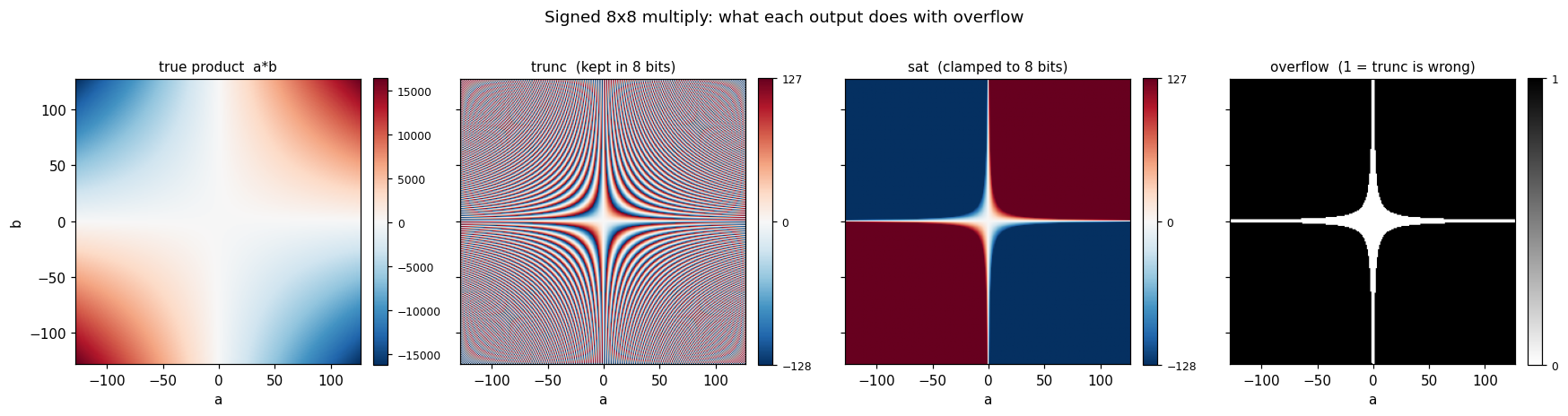
The true product is smooth. trunc is chaos — the bands are the value wrapping
round and round as the product grows, and neighbouring inputs land in completely
different places. sat keeps the sign and the general shape, and pays for it by
flattening to ±127/-128 across most of the plane: it is wrong about the
magnitude, but never wrong about which way the answer points.
The last panel is the overflow mask. The white region — where 8 bits are genuinely enough — is a thin hyperbola around the axes. Everything black is a wrong answer waiting to happen.
Checking against Python
The build compares the SystemVerilog output against the Python golden model for every one of those 65,542 rows (the six teaching vectors, then the full grid):
python datatypes_build.py --through int_prod_check
If any row disagrees, the check stops the build and reports the first difference. If none does, the two implementations are equivalent — not “seem to work”, but equivalent, over the entire input space.
Go to the Python golden model.