Packing a Sample Into a Word
Hardware moves data over buses of a fixed width, so a structure with several fields has to be squeezed into a word and pulled apart again at the other end. This part of the demo does that for a timestamped complex sample:
| field | width | type |
|---|---|---|
time |
8 | unsigned |
real |
12 | signed |
imag |
12 | signed |
| 32 | = exactly one word |
Eight plus twelve plus twelve is thirty-two, which is not a coincidence. This is roughly how a stream of samples from an ADC or a radio front end is carried over a 32-bit bus, and you will meet the same layout again when we get to streaming interfaces.
The layout, most significant bit first:
bit  31..24 : time   (8b unsigned)
bit  23..12 : real  (12b signed)
bit  11..0  : imag  (12b signed)
Packing
word = {t_in, re_in, im_in};
That is the whole of it — a concatenation, written with braces, laying the three fields end to end.
It costs something, though, and the cost is easy to miss: a concatenation result
is always unsigned, whatever the pieces were declared as. re_in was
logic signed [11:0], but once it is inside word that fact is gone. Nothing
in the bits records it. Signedness is not a property the data carries around; it
is a decision about how to read it, and packing throws the decision away.
Which means unpacking has to make the decision again.
Unpacking, and the bug that is waiting there
    t_out  = word[31:24];
    re_out = $signed(word[23:12]);   // sign-extends -> correct
    im_out = $signed(word[11:0]);

    re_bad =         word[23:12];    // zero-extends -> wrong
re_out and re_bad slice exactly the same twelve bits. They differ only by
$signed, and they disagree on every negative sample.
The reason is the rule from int_prod: a part-select is always
unsigned. Those twelve bits are just bits. Widening them into a 16-bit
destination has to fill the top four bits with something, and unless you say
otherwise the answer is zero — so 0xC18, which is -1000 as a 12-bit signed
value, arrives as +3096.
Note that this only shows up because the destination is wider than the field. Unpacking a 12-bit field into a 12-bit variable would appear to work: the same bits, read the right way, by luck. Real code unpacks into a working register that is wider, and that is where it bites.
What it looks like
The demo packs 100 samples, unpacks them both ways, and plots them on the complex plane with the timestamp as colour:
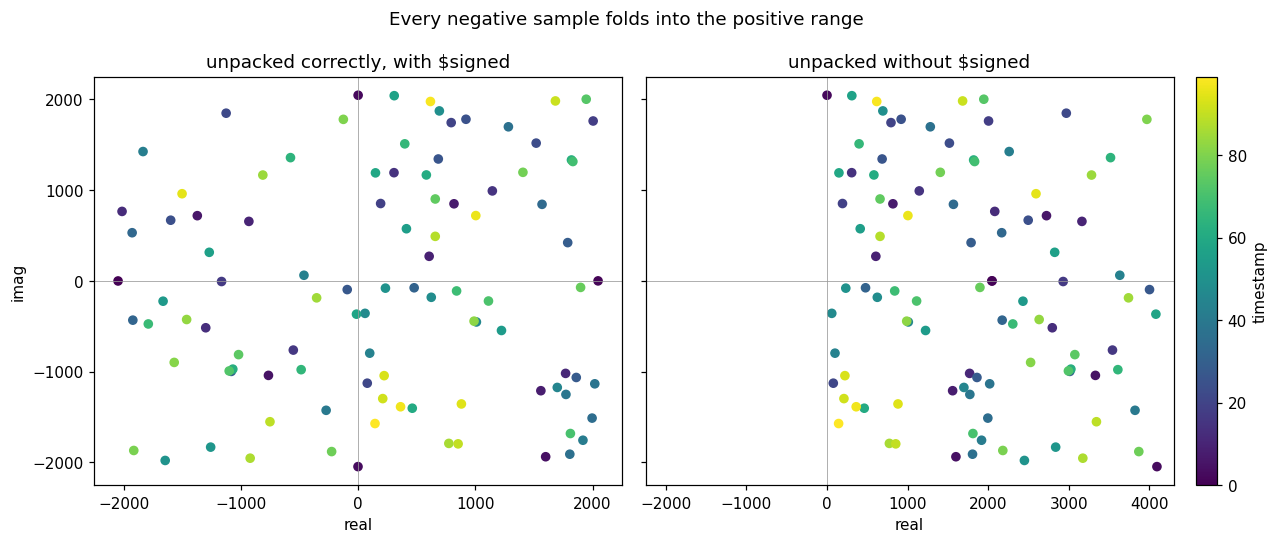
On the left, samples fill all four quadrants, as they should. On the right, the left half of the plane is empty — every sample that had a negative real part has been folded up into the range 2048–4095, on top of the samples that were legitimately positive. The data is not merely wrong, it is unrecoverably mixed together.
Two things get checked
tb_samp_pack.sv reads the samples, packs and unpacks each one, and the build
checks two separate claims:
- Cross-language. The 32-bit word SystemVerilog built is bit-for-bit the word Python built.
- Round trip.
unpack(pack(x)) == x, for every sample.
The second one is a different kind of check from anything in int_prod: a
property, holding for all inputs, rather than a comparison against stored
answers. See two ways to check an answer
for why it is worth reaching for a property whenever you can state one.
The vectors deliberately include the awkward cases: the most negative value
(-2048), the most positive (2047), zero, and -1. The first rows the
testbench prints are exactly those:
   t     re     im |     word (hex) | t_out  re_out  im_out |  re_bad
-------------------+----------------+-----------------------+---------
   0  -2048     -1 |       00800fff |     0   -2048      -1 |    2048
   1   2047      0 |       017ff000 |     1    2047       0 |    2047
   2      0   2047 |       020007ff |     2       0    2047 |       0
   3     -1  -2048 |       03fff800 |     3      -1   -2048 |    4095
   4   1600  -1939 |       0464086d |     4    1600   -1939 |    1600
   5   -765  -1042 |       05d03bee |     5    -765   -1042 |    3331
re_out is right in every row. re_bad matches it on the positive samples and
is wrong on every negative one: -2048 becomes 2048, -1 becomes 4095,
-765 becomes 3331.
Python and SystemVerilog have opposite defaults
The same packing in Python looks like this:
word = ((t & 0xFF) << 24) | ((re & 0xFFF) << 12) | (im & 0xFFF)
The masks are not decoration. Python integers are unbounded, and a negative
value has infinitely many leading one bits — so without & 0xFFF a negative
real part would run straight over the timestamp above it.
SystemVerilog needs no masks here at all, because the field widths are declared and the language does the truncation for you.
That is the general shape of the difference — Python keeps every bit unless you remove it, SystemVerilog removes every bit that does not fit — and it is the single most common reason a model and an RTL implementation disagree. It is covered in where Python will trip you.