Fitting the model
The corpus is 12 ground-truth (n_row, n_col) → cycles rows. Fitting turns it into
the timing model. The headline is how little is fit.
Fit the primitives, not the whole-kernel
The discipline is to fit each physical primitive, never the emergent whole-kernel directly (that would manufacture a fudge term — see the playbook). For FIR three of the four terms need no fit at all:
- Channel occupancy — read off the transfer-beat counts: exactly
nwords, slope 1. Deterministic. - Compute body —
trips + (n_row−1)·row_depth; the II=1 part fits single-row points to R²=1.0. Exact. fill_const— one scalar, the residual command→bus latency.
The only fitted curve is row_depth(n_col) — the per-row ping-pong refill depth — recovered
from the inter-row gaps and carried as a saturating InterpCalibModel
lookup (not a sqrt basis fudge):
db = CalibDataFrame.load("results/cosim_grid.json")
# row_depth measured from the inter-row gap: (y_write_span - trips) / (n_row - 1), per n_col
row_depth = InterpCalibModel(basis=["n_col"], target="row_depth").fit(gaps)   # the one curve
# occupancy + II=1 compute are deterministic; only fill_const is a scalar mean
Measured, it saturates — row_depth(64) ≈ 70, (256) ≈ 260, (1024) ≈ 268 cycles — at the FIR
pipeline depth. The fitted model is committed in
results/fir_calibration.json, and the
full derivation in
results/fir_calibration_results.md.
The result
The simulation loads the calibration and composes whole = fill + max(write_occ, compute_body). Against
the RTL cosim it reproduces the whole-kernel to ≤ 1.3% across the grid, with the honest
generalization tests well inside that:
| gate | point | sim | cosim | rel-err |
|---|---|---|---|---|
interior held-out (n_row=2 out; row_depth(256) trained) |
(2, 256) | 1341.5 | 1343 | 0.11% |
untrained n_col (row_depth interpolated) |
(4, 128) | 1211.3 | 1213 | 0.14% |
untrained n_col (row_depth interpolated) |
(4, 512) | 3651.0 | 3673 | 0.60% |
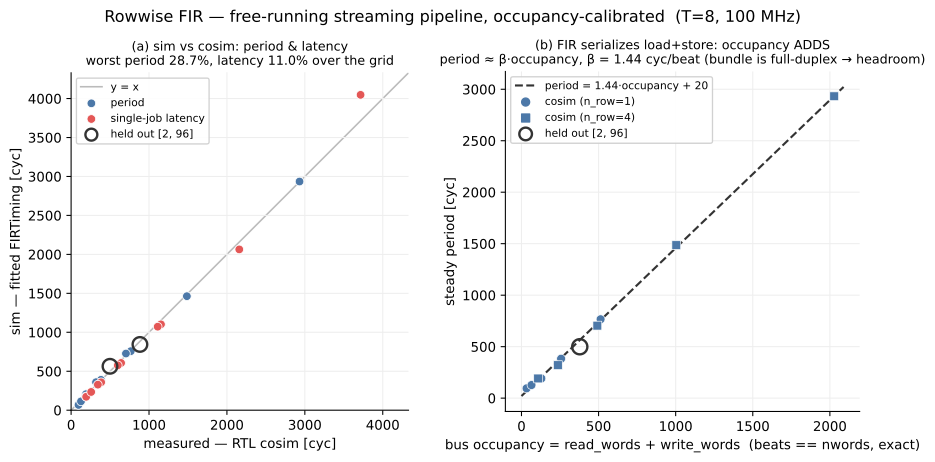
Panel (a) is the parity of predicted vs measured: every grid point — and the untrained-column held-out points — lands on the diagonal. Panel (b) is the single fitted curve.
What the residual says
The one fitted term, row_depth(n_col), is a per-row quantity. At this block (per-matrix)
granularity the model can only see it summed as n_row·row_depth and must carry it as a measured
curve. A finer per-row (row-LT) model would treat it as each row’s pipeline depth and obtain it
fit-free — so the residual is a single, physically-named, per-row quantity rather than diffuse
curvature. That is the quantified motivation for the next fidelity level.
Reproducing the figure
The figure regenerates from the committed JSONs alone — no Vitis, no cosim — via
fir_figures.py, deterministic (fixed svg.hashsalt),
with --check for a byte-match gate:
PYTHONPATH=. ../pysilicon-venv/Scripts/python.exe examples/rowwise_fir/fir_figures.py          # regenerate
PYTHONPATH=. ../pysilicon-venv/Scripts/python.exe examples/rowwise_fir/fir_figures.py --check  # byte-identical?
See also
- The timing model — the decomposition these terms fill in.
- Calibration — the corpus and models (
row_depthis anInterpCalibModel). - Fitting a timing model — the general fit this specializes.