SALSA — the system Waveflow was built for
Emerging wireless systems face two demands at once: massive-scale MIMO — fully-digital, high-dimensional antenna arrays for beamforming, interference coordination, and high-resolution sensing — and spectral agility — the ability to rapidly change the frequency of operation and reconfigure processing for joint communication and sensing, resiliency, and dynamic spectrum use.
SALSA (Spectrally Agile Large-Scale Arrays) is a large NTIA NOFO-2 project at NYU developing massive (1000+ element) antenna systems for future wireless. A central focus is the emerging FR3 band (6–24 GHz), where cellular systems must coordinate with incumbent satellite services. Large-scale reconfigurable platforms like SALSA are also key to integrated sensing-and-communication (ISAC) and to the resiliency of commercial and public systems against interference and hostile attack.
SALSA was the actual motivation for Waveflow — and it is exactly the kind of system that current AI-assisted hardware tools cannot build reliably.
Why SALSA is hard
SALSA represents a class of modern wireless architecture that combines heterogeneous accelerators, high-rate antenna interfaces, and dynamic dataflow reconfiguration. That combination demands three things existing tools do not provide together:
- architectural exploration — over the tile mix, the interconnect, and the dataflow graphs;
- concurrency modeling — many dataflows run simultaneously and reconfigure at runtime;
- unified firmware generation — the control that programs the dataflow must stay in lock-step with the hardware it drives.
And the reconfigurability problem made concrete: because SALSA’s behavior is runtime-programmable and data-dependent, timing and resource contention cannot be reasoned about statically. The only way to see how a given task mix performs is to simulate it — fast, bit-exact, and timing-aware.
The architecture
SALSA is a tile-based wireless processor — not a fixed pipeline, but a runtime-programmable dataflow machine whose behavior changes with the wireless environment and the application. It is organized in three levels around a shared bus:
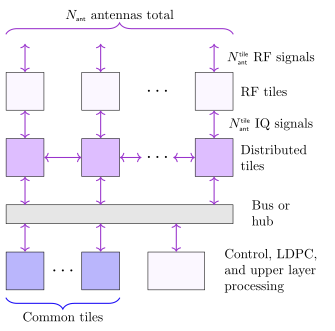
- RF tiles sit at the antennas — each drives the RF front-end for a group of the antenna elements, exchanging that group’s IQ streams with the layer below.
- Distributed tiles do the per-antenna or per-user signal processing. Crucially they connect to their neighbors (left/right) as well as up to the RF tiles and down to the bus — this neighbor-to-neighbor mesh is what lets array-wide operations (beamforming, angle-of-arrival, nulling) span tiles.
- Common tiles perform multi-user processing, including certain MIMO matrix operations.
LDPC decoders, physical-layer control, and upper-layer processing are handled outside the SALSA tile array, since they are better suited to specialized hardware or more general-purpose DSPs and processors.
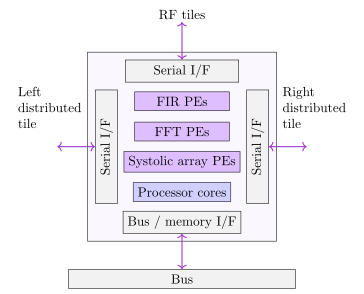
Each distributed tile is itself heterogeneous — FIR, FFT, and systolic-array processing elements plus general-purpose processor cores, sharing the tile’s memory and fed by serial interfaces (up to the RF tiles, left/right to neighbor tiles, and down to the bus):
Dynamic Task Reconfiguration
Dynamic processing is configured in flows in an architecture that builds on the team’s work in the DARPA TRACER project. Specifically, computation is performed in flows, with each flow being a sequence of atomic operations or tasklets. For example, a flow could consist of tasklets such as channelization filtering, FFT, spatial covariance estimation, and an eigenvector-based AoA estimation that could be activated, for example, after a signal of interest and its bandwidth are identified.
Each tasklet in a flow is run on a PE specific to the type of processing and exchanges messages and data with other tasklets on other PEs over the interconnect fabric and shared memory. Importantly, PEs may be assigned multiple tasklets and have a job queue and micro-scheduler for selecting tasklets to process.
The flow configuration across this fabric is workload-dependent: each flow — communication, spectrum sensing,
angle-of-arrival, beam nulling, interference mitigation — lights up a different graph across the tiles and
PEs, and several run concurrently.
Building SALSA with Waveflow
Waveflow is the single executable model for exactly this kind of system — each piece of SALSA maps onto a Waveflow abstraction, and the whole thing simulates, verifies, and generates from one source:
- Tiles and their PEs are
HwModules. A distributed tile — and each processing element inside it (FIR, FFT, systolic, vector) — is aHwModulewith typed interfaces (the Serial I/F and Bus/memory I/F of the figure above) and a compute hook: modeled in Python, simulated at NumPy speed, verified bit-exact against its golden, and lowered to HLS. The reconfigurable vector-MAC engine (VMAC) is the first PE through that flow — already bit-exact on real Vitis and throughput-characterized — a concrete SALSA building block, not a sketch. - The tasklet vocabulary maps straight onto Waveflow. A tasklet is a compute hook on a PE
HwModule; a flow is a sequence of tasklets wired through the typed interfaces; and a PE’s job queue + micro-scheduler is an AXI-MM command-queue interface feeding the hook. So the one model that simulates a tasklet bit-exact also describes the queue that schedules it — one source for the compute and its dispatch. - The dataflow fabric is interfaces + concurrency. Tiles connect through typed, transactional interfaces, and the simulator runs them as truly concurrent processes, so the simultaneous, runtime-reconfigured dataflows that define SALSA are modeled directly — something a sequential HLS testbench cannot express.
- Architectural exploration is fast and honest. Because the model is fast, bit-exact, and timing-aware, you can sweep the tile mix, the fabric, buffering, and the flow graphs in Python — the design-space exploration a runtime-programmable dataflow machine needs but static analysis can’t deliver.
- Firmware comes from the same source. The control that programs the dataflow — the per-tile commands and the routing — is generated alongside the hardware from the one model, so the firmware and the silicon cannot drift.
- Verification is end-to-end and bit-exact. Every tile is checked against its Python golden on the real toolchain; the system is simulated against the very wireless algorithm it implements.
SALSA is a reconfigurable, concurrent, heterogeneous system whose correctness, performance, and firmware must all be reasoned about together — and Waveflow keeps them in one fast, bit-exact, executable model. VMAC is the first tile through that flow; the rest of SALSA follows the same path.
References
- French, Matthew, et al. “TRACER, the Next Generation Ultra-wideband Spectrum Processor.” MILCOM 2025-2025 IEEE Military Communications Conference (MILCOM), 2025.
- Rasteh, A., Hennessee, A., Shivhare, I., Garg, S., Rangan, S., & Reagen, B. “A Spatial Array for Spectrally Agile Wireless Processing”, IEEE Asilomar, 2025
- Rasteh, A., Kiani, A., Mezzavilla, M., & Rangan, S. “Scalable Long-Term Beamforming for Massive Multi-User MIMO,” arXiv preprint arXiv:2511.09464, 2025
- Kang, S., Mezzavilla, M., Rangan, S., Madanayake, A., Venkatakrishnan, S. B., Hellbourg, G., … & Dhananjay, A. “Cellular wireless networks in the upper mid-band”, IEEE Open Journal of the Communications Society, 5, 2058-2075, 2024