Reading the trace
RTL simulation produced bram_access_top_trace.vcd. This page reads it: what the design
did, whether it did anything it was not allowed to, how long the memory really takes to answer, and
how all of that compares with the Python model.
Unlike every other timing page in this tree, the lanes here are the memory’s own pins. buf_w
and buf_r are wires of the wrapper — the join between the kernel’s mode=bram ports and
bram_t2p — so a level-1 $dumpvars sees them, and the picture shows the memory being used rather
than inferring it from the streams at the boundary.
One run, four lanes
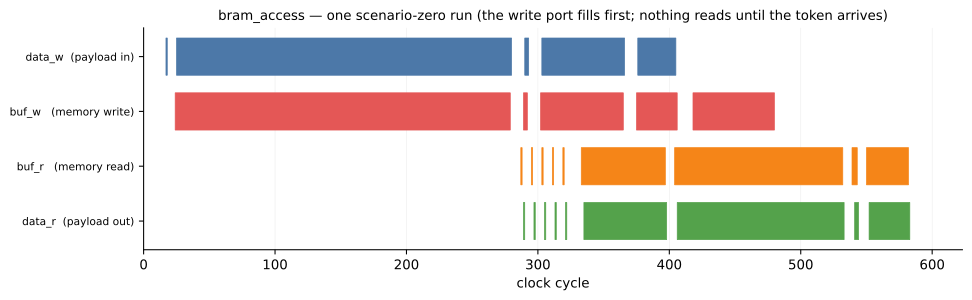
Reading it left to right: the payload arrives, the write port is busy for 256 cycles, and both read
lanes are empty the entire time. That emptiness is the arming token doing its job — the reader is
blocked on go until the writer’s first command completes. Then the answers start, and from roughly
cycle 320 the write and read lanes are busy together.
The event counts say the same thing more precisely, and one of them is a surprise:
from pathlib import Path
from examples.bram_access.bram_access_build import hazard_manifest
from examples.bram_access.bram_access_figures import lanes

ll = lanes(Path("examples/bram_access/xsi/bram_access_top_trace.vcd"), hazard_manifest())
for label, ev, _colour in ll:
    print(f"{label:26s} {len(ev):4d} beats   first {ev[0]:3d}  last {ev[-1]:3d}")
data_w  (payload in)        356 beats   first  17  last 405
buf_w   (memory write)      388 beats   first  24  last 480
buf_r   (memory read)       242 beats   first 287  last 582
data_r  (payload out)       233 beats   first 289  last 583
356 payload words in, 388 memory writes — and the memory is written more than it is fed. The
32 extra writes are the COMPUTE: it takes no payload at all and rewrites 32 words it read from the
memory itself. That asymmetry is the transaction’s whole signature, and it is legible here before
any timing argument is made.
242 read enables for 233 returned words. Nine of the ten read commands return data, and each
presents one address past the end of its range as the pipeline drains. That extra enable is why the
read-latency measurement below skips addresses whose contents are unknown: word 256 was never
written, and at RTL a never-written word is X.
The cycle numbers on this page are the waveform’s
The figures and the scan count rising edges from the start of the dump, which includes the 16
reset cycles the harness holds before the run loop begins. The sinks’ cycles.bin counts from the
first post-reset cycle instead. The two differ by a constant, and it is worth knowing which is which
before comparing a figure against a gate:
import numpy as np
from pathlib import Path
from examples.bram_access.bram_access_build import hazard_manifest
from examples.bram_access.bram_access_figures import lanes

xsi = Path("examples/bram_access/xsi")
vcd_beats = [ev for label, ev, _c in
             lanes(xsi / "bram_access_top_trace.vcd", hazard_manifest())
             if label.startswith("data_r")][0]
sink = np.fromfile(xsi / "vectors" / "data_r" / "cycles.bin", dtype="<u8")
print("words:", len(vcd_beats), len(sink),
      "| offset:", sorted({int(d) for d in vcd_beats - sink}))
words: 233 233 | offset: [15]
Exactly 15 on every one of the 233 words. The gate’s 568 and the figure’s 583 are the same
instant.
The overlap, beat by beat
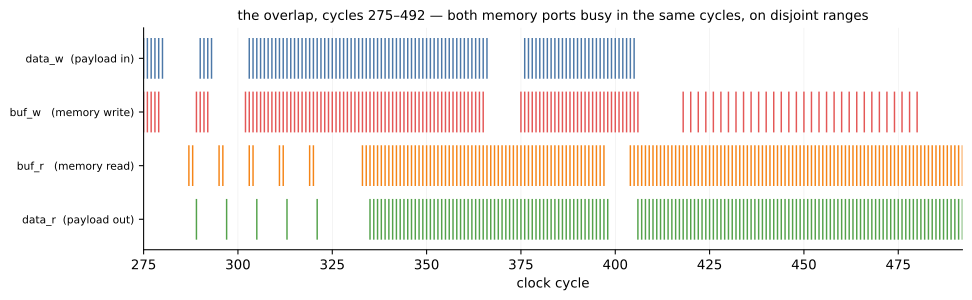
The zoom is picked from the run rather than written down — the window is derived as the cycles in which the read port is active inside the write port’s span — so it cannot drift away from the thing it is meant to show.
Three things are legible here that the whole-run view flattens:
- Each single-word read is a pair of
buf_rhairlines: the address it was asked for, and the one the pipeline presents behind it. buf_wandbuf_rfire in the same cycles, continuously, through the phase-2 window. This is a true-dual-port memory doing the thing it exists for.- Later in the run there is a stretch where
buf_wbeats are only half as dense. That is theCOMPUTE, and it is measured below.
Overlap is legal here, and that is the interesting part
Scenario zero runs the write side through three phases:
- Phase 1 — no overlap. The witness. Load 256 words, then read. Nothing else is live.
- Phase 2 — deliberate overlap.
write(64, 64)runs whileread(0, 64)is outstanding. Disjoint ranges, so it is legal. - Phase 3 — in place.
write(512, 32)seeds a region andcompute(512, 32)rewrites it, with the read of that region deliberately last on the reader’s stream.
Phase 2 is where “no hazard” stops being structural and becomes conventional. Compare
RfShotBuf, whose entire safety argument is that the reader and the writer are
never live at the same time; this design permits the overlap and hands the caller the obligation.
Sequencing belongs in the design
is where the one piece of ordering it does own — the arming token — is argued.
That overlap is asserted rather than admired, and in cycles — because the two ranges are disjoint, so the returned words are identical whether the two overlapped or ran one after the other:
import numpy as np
from pathlib import Path
from examples.bram_access.bram_access import WriteResp, resp_words, scenario_zero

sc = scenario_zero()
xsi = Path("examples/bram_access/xsi")
data = np.fromfile(xsi / "vectors" / "data_r" / "cycles.bin", dtype="<u8")
resp_w = np.fromfile(xsi / "vectors" / "resp_w" / "cycles.bin", dtype="<u8")
lo, hi = sc.overlap_read
when = int(resp_w[resp_words(WriteResp, sc.overlap_write_resp + 1) - 1])
print(f"read window [{int(data[lo])}, {int(data[hi - 1])}], phase-2 write done at {when}")
print("overlapped:", int(data[lo]) <= when <= int(data[hi - 1]))
read window [320, 383], phase-2 write done at 353
overlapped: True
A sink timestamps every word, and a response is two of them — so the index goes through
resp_words, which asks the schema, rather than through a 2. The response grew from one word to
two the day it gained a tid; a literal would not have noticed, and the index would have quietly
pointed into the middle of a message.
What it costs to read a word you are about to write
This is the measurement the example exists for, and it is a controlled experiment: the same task writes 32 words at 512, and then rewrites those same 32 words in place, adjacent in time, through the same port. Everything except the access shape is held constant.
import numpy as np
from pathlib import Path
from examples.bram_access.bram_access_build import hazard_manifest
from waveflow.utils.bram_trace import port_samples

w = port_samples(Path("examples/bram_access/xsi/bram_access_top_trace.vcd"),
                 hazard_manifest(), "write")
we = np.nonzero(np.asarray(w.we) != 0)[0]
addr = np.asarray(w.addr)

groups, cur = [], [we[0]]                       # a gap longer than the II ends a command
for c in we[1:]:
    if c - cur[-1] <= 6:
        cur.append(c)
    else:
        groups.append(cur); cur = [c]
groups.append(cur)

for g in groups:
    n, span = len(g), g[-1] - g[0] + 1
    print(f"addr {int(addr[g[0]]):4d}..{int(addr[g[-1]]):4d}  {n:3d} writes over {span:3d} "
          f"cycles ({g[0]}..{g[-1]})  ->  {span / n:.2f} cycles/element")
addr    0.. 255  256 writes over 256 cycles (24..279)  ->  1.00 cycles/element
addr 1020..1023    4 writes over   4 cycles (289..292)  ->  1.00 cycles/element
addr   64.. 127   64 writes over  64 cycles (302..365)  ->  1.00 cycles/element
addr  512.. 543   32 writes over  32 cycles (375..406)  ->  1.00 cycles/element
addr  512.. 543   32 writes over  63 cycles (418..480)  ->  1.97 cycles/element
The last two rows are the experiment. 32 words written in 32 cycles; the same 32 recomputed in
place in 63. csynth says the same thing in its own units — the achieved PipelineII is 1 for
write_payload and 2 for compute_inplace — and the two agreeing is worth more than either alone,
because the report is a schedule and the waveform is a run.
The number is a consequence, not a property of in-place work. “In place is II=2” is false in general. What is true is a chain, and every link of it is checkable:
- The wrapper wires one physical memory port per declared
bramport. - So
buf_w, beingaccess="readwrite", carriesstorage_type=ram_1pon its pragma, which declares no second port pair at all. - So the scheduler has one port to spend, and a read-modify-write needs two accesses per element.
- So the loop runs at II=2, and
ii_for(2)in the Python model says 2 for the same reason.
Under ram_1wnr the same loop reaches II=1 — by reading on port B while writing on port A. That
is faster and it is wrong: the wrapper wires only the A halves, so those reads reach a dangling
port, and nothing says so until RTL. The
access / storage_type derivation
is what makes the safe choice the one you get.
The hazard that cannot be heard
The design permits the overlap, so keeping the ranges disjoint is the caller’s job. bram_t2p.v
carries the guard for a caller who gets it wrong — and in this flow nothing can hear it.
That is measured, not suspected. In the XSI shared-library flow (Vivado 2025.1, xelab -dll plus the
C++ loader), RTL text output is discarded: $display from an always block reaches neither stdout
nor a file, an initial $display at time zero does not either, and a non-null
s_xsi_setup_info::logFileName produces no log — although it does change the kernel’s invocation
from -nolog to -log <name>, visible in xsim.dir/<top>/xsimkernel.log. Only an $fwrite to a
file the Verilog opens itself works, which is how the $error’s firings were counted in the first
place.
The cost was concrete: five shipped XSI gates asserted that the string
"read-during-write collision" was absent from a run’s output — a string that could never appear —
and each read as positive evidence. All five have been removed.
So the condition is checked instead, from the waveform, using nets named by the emitter that made them rather than matched by substring:
from pathlib import Path
from examples.bram_access.bram_access_build import hazard_manifest
from waveflow.utils.bram_trace import describe, find_read_during_write

vcd = Path("examples/bram_access/xsi/bram_access_top_trace.vcd")
print(describe(find_read_during_write(vcd, hazard_manifest())))
no read-during-write collisions
An empty scan is not a passing gate
No collisions is what a correct design looks like. It is also what a renamed net, a dump that never
ran, and a scan bound to the wrong scope look like. So the gate is a pair: scenario zero must come
back clean, and a scenario built to collide must come back dirty. collision_scenario() is the dirty
half, and on the run recorded here it produces 24 collisions on words 128–135.
Building that scenario turned out to be the interesting part, because address overlap alone is not
a collision. The memory’s condition is a_addr == b_addr in the same cycle, and both tasks sweep
their range at one word per cycle — so two commands over the identical range are parallel lines in
(cycle, address) and never meet unless they happen to start in the same cycle. What makes them meet
is a relative phase that moves, so the scenario gives the writer and the reader command lengths
that differ by one word:
from examples.bram_access.bram_access import collision_scenario

sc = collision_scenario()
w = [(int(c.waddr), int(c.nsamp)) for c in sc.cmd_w[1:]]
r = [(int(c.raddr), int(c.nsamp)) for c in sc.cmd_r]
print("writes:", w[0], "x", len(w), " reads:", r[0], "x", len(r))
print("ranges overlap:", max(w[0][0], r[0][0]) < min(w[0][0] + w[0][1], r[0][0] + r[0][1]))
print("lengths differ:", w[0][1] != r[0][1])
writes: (128, 8) x 48  reads: (128, 9) x 48
ranges overlap: True
lengths differ: True
Each round shifts the two by one cycle relative to each other, and within a few dozen rounds every
offset in the window has been visited. Both halves are gated in
tests/examples/test_bram_access_xsi.py.
The durable fix is neither a print nor a trace scan but a sticky collision output on the memory,
carried through the wrapper and readable in both backends by construction. That is a BramIF
interface change and is not done.
The read latency, measured off the memory’s own pins
bram_t2p.v publishes localparam READ_LATENCY = 1, and Waveflow emits both the kernel’s
latency=1 pragma and the pysim model’s delay from that one line. But that is two files agreeing,
not evidence about the hardware. The waveform can be asked directly: at what distance from the
address does the answer appear?
from pathlib import Path
from examples.bram_access.bram_access import BASE, DEPTH, SENTINEL_BASE
from examples.bram_access.bram_access_build import hazard_manifest
from waveflow.utils.bram_trace import measured_read_latency, port_samples

def expected(addr):
    if 64 <= addr < 128:
        return None                  # phase 2 rewrote these mid-run
    if addr < 256:
        return BASE + addr           # the witness's ramp
    if DEPTH - 4 <= addr < DEPTH:
        return SENTINEL_BASE + (addr - (DEPTH - 4))
    return None                      # computed in place, or never written (X at RTL)

port = port_samples(Path("examples/bram_access/xsi/bram_access_top_trace.vcd"),
                    hazard_manifest(), "read")
print("offsets that explain every read:", sorted(measured_read_latency(port, expected)))
offsets that explain every read: [1]
A set, on purpose. One element is the number; more than one means the scenario cannot tell those offsets apart; none means the answer never appears where the data says it should — a real defect rather than an off-by-one in the measurement. And a single element is only decidable because the payload is a ramp: with a constant payload every offset would fit, which is the same failure the ramp prevents in the value check.
And the pysim does not match — for free
A reader arriving from mem_copy will expect a section called “And the pysim
matches — for free.” That page can say it; this one cannot, and the difference is the whole of
objective 4.
The throughputs match for free. Both backends deliver the 64-word read at one word per cycle.
Nothing in the Python model was tuned to make that true — a StreamIF with a clock and an RTL loop at
II=1 simply agree.
The first word does not. It is off by exactly READ_LATENCY unless the model pays it:
import numpy as np
from pathlib import Path
from examples.bram_access.bram_access import run_pysim, scenario_zero

sc = scenario_zero()
lo, hi = sc.cadence_read
rtl = np.fromfile(Path("examples/bram_access/xsi/vectors/data_r/cycles.bin"), dtype="<u8")
tb = run_pysim(sc=sc)

def gaps(c):
    return sorted(set(np.diff(np.asarray(c)[lo:hi]).tolist()))

port, n = tb.dut.rd.buf_r, hi - lo
env, t0 = port.env, port.env.now                      # the run is over; drive one more read
proc = env.process(port.read_pipelined(port.element_type, n, 0))
env.run(until=proc)
cost = round((env.now - t0) * float(port.interface.clk.freq))

print("cycles per word   RTL", gaps(rtl), " pysim", gaps(tb.data_r_snk.cycles))
print(f"a {n}-element read costs {cost} cycles = READ_LATENCY {int(port.read_latency)} + {n}")
cycles per word   RTL [1]  pysim [1]
a 64-element read costs 65 cycles = READ_LATENCY 1 + 64
The fill is measured as the content of the model, not as absolute agreement between the backends: pysim is a discrete-event model of the streams around the memory, not a cycle-accurate model of the kernel, so its absolute cycle numbers are its own. What has to be exact is the term.
This used to be a subtraction — run the design twice with a model_read_latency flag on and off, and
check the difference was READ_LATENCY. The flag existed only because the fill was hand-written in
the design body, yield self.timeout(self.buf_r.read_latency / freq), with nowhere else to put it.
It is BramIFMaster.read_pipelined’s term now, so there is no “off”
configuration to subtract from and the number is read where it lives.
Why a memory is different from a bus. mem_copy’s free match comes from calibrated models of an
m_axi bus and the mem-stream adaptors — components whose timing is a (component, platform)
property that ships with Waveflow. A BRAM has no such model and does not want one: its access is
deterministic, unarbitrated and one cycle, so a discrete-event model of it would add a SimPy timestep
and no fidelity. What that buys is a model with nothing to calibrate; what it costs is exactly one
cycle of pipeline fill, paid explicitly, once per command.
And it is a fill, not a per-word cost — which a first-word check alone would not catch. A model paying the latency per word would match RTL on the first word and be 64 cycles late by the end of a 64-word read:
import numpy as np
from examples.bram_access.bram_access import run_pysim, scenario_zero

sc = scenario_zero()
lo, hi = sc.cadence_read
c = np.asarray(run_pysim(sc=sc).data_r_snk.cycles)
print("word-to-word gaps through the 64-word read:", sorted(set(np.diff(c[lo:hi]).tolist())))
word-to-word gaps through the 64-word read: [1]
How the figures are committed and refreshed
Both SVGs on this page are committed assets, not rendered at build time. The workflow is the one
mem_copy and shared_mem use:
cd examples/bram_access
python bram_access_build.py --through rtl_trace          # the waveform
python bram_access_build.py --through activity_figures   # -> results/ (gitignored)
python bram_access_build.py --through sync_docs_figures  # -> docs/.../images/ (committed)
SyncDocsFiguresStep copies each figure named in an explicit manifest, so a docs figure only
changes when someone runs that step — and the change arrives as a reviewable git diff of the SVG
rather than as a silently different picture.
It also writes images/sync_status.json with each figure’s source path and content hash. That file
is not tracked — a blanket *.json rule ignores it, here and for every other example that writes
one — so it is a local staleness signal you can check by hand, not a reviewable record. The
committed artifact is the SVG.
The SVGs are deterministic: matplotlib.rcParams["svg.hashsalt"] is fixed and the date metadata
is suppressed, so re-rendering an unchanged figure produces a byte-identical file. Without that, every
refresh would diff.
One caveat worth knowing: rtl_trace is not re-run just because the waveform on disk changed under
it. If you have run the -m xsi gate since — which leaves the collision vectors and the collision
waveform behind — force the step, or the figures will be of the wrong run:
python bram_access_build.py --through sync_docs_figures --force-step rtl_trace
See also
- Python simulation — the same measurements from the Python side.
- BRAM — memory between modules — the interface, and the addressing convention the wrapper reconciles.
mem_copy’s timing page — the free match, and the calibration behind it.- Timing models — what a forward model is, and when a component needs one.