Playing a stored waveform
examples/rf_shot_tx is the worked example for RfShotTx — the
transmit half of the finite sample buffer. A host hands it a waveform once; it holds it in a BRAM and
plays it at the converter’s own rate, answering every command with exactly one verdict.
This page is about the example. What the design is — the protocol, the two play modes, the five verdicts, the lock underneath — is the guide’s, and this page links rather than restates.
StreamDriver --[ShotTxHdr | dense words … TLAST]--> RfShotTx.s_in
RfShotTx.resp_out --> StreamSink            (one ShotTxResp per header)
RfShotTx.samp_out --> Rfdc.tx_streams[0] | Rfdc.tx_rf --RFSampIF--> RfDataSink
What it plays
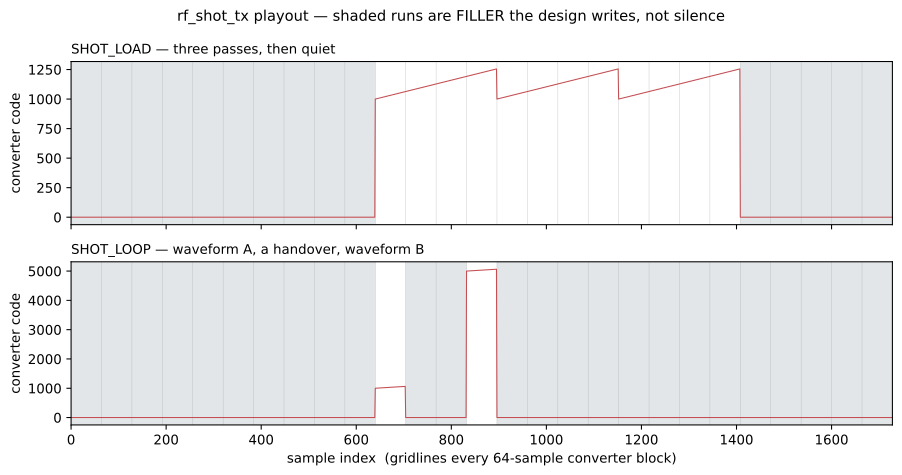
The shaded runs are filler — the value the design writes when it has nothing to play. They are not gaps: a converter comes due on a fixed grid, and a design that stopped writing would starve it. Reading the figure top to bottom is reading the whole design:
- Above, the finite path. A
SHOT_LOADfor three passes. The waveform repeats exactly three times and then the design goes quiet — it stopped on purpose rather than running out of stream. Everything arriving behind it is answeredSHOT_BUSY. - Below, the infinite path. A
SHOT_LOOPstarts playing; a second load arrives mid-play and preempts it. The gap between the two waveforms is the handover — how long the converter plays filler while the memory changes hands, because this design holds one region. The long tail is aSHOT_SHORTload that is stored and then never played.
The figure is rendered from the pysim run and regenerates with no toolchain; it is a picture of
the RTL because test_the_two_backends_agree_after_their_own_transients asserts every played sample
agrees once the two captures are aligned on their own playout logs.
The leading shaded run is longer here than it is at RTL, and that is the model rather than the
design. Since plans/lt_transient.md
S2 the pysim player carries no metronome: it is paced by back-pressure alone, which controls how fast
it may go and not how far ahead of the data it may get. While it owns nothing to play it writes
filler, so a shot loaded later queues behind whatever filler is already in flight — 448 samples of
it, the sum of the declared depths along the path. Everything after that first transition is
sample-for-sample what the RTL does.
Two scenarios, and they cannot be one
The example drives one design with two command bundles — vectors/cmd and
vectors/cmd_loop — through two hand-written XSI mains that differ only in three bundle names. That
the RTL is the same in both is the claim; a second testbench graph would be a second model of one
design.
They cannot be a single stream, and the reason is the design rather than the harness. A file-driven
driver never reads a verdict, so a stream that opens with a finite shot has every later frame
answered SHOT_BUSY — that is what SHOT_BUSY is — and a stream that opens with an infinite
one can never demonstrate a refusal. One scenario per opcode is the minimum.
vectors/cmd |
vectors/cmd_loop |
|
|---|---|---|
| opens with | SHOT_LOAD, nrepeat = 3 |
SHOT_LOOP |
| verdicts produced | LOADED, BUSY, BAD_OPCODE, BAD_OPCODE, END→LOADED |
LOADED, BAD_OPCODE, BAD_OPCODE, LOADED, SHORT, END→LOADED |
| what it proves | a finite shot is not truncated | a load mid-play preempts, and a short shot never plays |
Between them every legal verdict is exercised — asserted by
test_all_five_verdicts_and_the_fence_appear_across_the_two_streams.
The geometry
| value | what it is | |
|---|---|---|
depth |
64 words | the memory, and therefore one shot — 256 samples at 4 samples/word |
blk_words |
16 | words per chunk: the lock poll period |
samp_rate |
256 MSa/s | the converter’s grid |
Two numbers, and it was four. nword (64 words, one shot) and base (192, placing the region at
the top of the memory) are gone — plans/rf_shot_geometry.md made the shot be the buffer, so
depth is the length as well as the size and there is nowhere else a shot could sit. depth is 64
rather than a rounder 256 deliberately: it is what nword was, so the played length is unchanged and
every recorded number on these pages stayed comparable across the change.
The addressing bug class went with base, rather than going untested. base + offset was the
shape of the byte-versus-word bug that had every BRAM design in this repo mis-addressed while a
smaller example stayed green, and the region sat at the very top so the arithmetic was exercised.
Without base there is no addition: the loader writes mem[i], the player reads mem[i], and the
wrap at depth is a mask. So test_the_write_addresses_reach_the_last_element_and_no_further now
asserts the writer touches exactly 0..63 — which is what says the counted load pass fills the
buffer — and test_the_player_sweeps_the_whole_buffer_and_wraps covers the one piece of arithmetic
that still exists.
Pages
- Running it — the build rungs, and what each produces.
- Taking it to RTL — the RTL run and every measured number, with the gate that asserts it.
Related
RfShotTx— the design: ports, messages, verdicts, the rules.- Internals — the tasks, the lock protocol, the findings.
examples/rf_shot_rx— the receive half of the same family.
Table of contents
- Running it - The build rungs for rf_shot_tx and what each produces: the SimPy golden that checks both scenarios, the lowering to an ap_ctrl_none top plus its memory and wrapper, the XSI harness and both command bundles, Vitis C-synthesis, and the two on-demand figure rungs that need no toolchain.
- Taking it to RTL - The XSI run for rf_shot_tx: one snapshot driven by two command bundles, thirty-one gates, and every measured number with the assertion that pins it. The playout block shapes, the last verdict's cycle, the converter counters that say the DAC was never starved, the write address range, the read pointer's sweep and wrap, the achieved II of five pipelined loops, the read-during-write collisions that are recorded as a measurement rather than asserted away, and the three loosely-timed gates that replaced one byte-identical comparison.