Transmit — RfShotTx
RfShotTx is the transmit half of the finite sample buffer. You hand it a waveform once; it
holds it in a BRAM and plays it at the converter’s own rate — a counted number of passes, or forever
until you replace it. Every command you send is answered by exactly one verdict.
It is the design to use when the waveform is decided before it is played: a repeating test signal, a channel-sounding sequence, a pulse train. If you need to change the samples while they are going out, without a gap, this is the wrong buffer — see choosing a sample buffer.
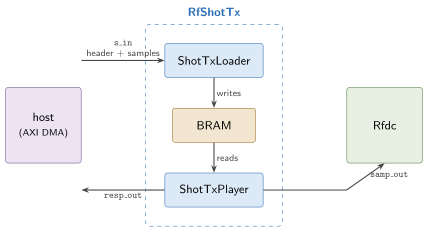
Three tasks and one memory between them. The host sends a header and, behind it on the same
stream, the samples; one verdict comes back per header. ShotTxLoader writes the shot into the
memory, and ShotTxPlayer reads it out at whatever rate the converter takes it.
The two tasks never touch the memory at the same time — how they hand it over is internal, and nothing you send depends on it.
Instantiating one
A typical RfShotTx module is instantiated as follows:
from waveflow.hw.rf_shot_tx import RfShotTx
from waveflow.hw.rfdc import Rfdc
from waveflow.hw.rfdc_samp_word import Rfsoc4x2SampWord

word = Rfsoc4x2SampWord.specialize(samp_per_word=4)
rfdc = Rfdc(name="rfdc", sim=sim, n_rx=0, n_tx=1, word=word)

dut = RfShotTx.for_word(
    word,
    depth=64,           # words in the memory, which IS the length of a shot -> 64 * 4 = 256 samples
    blk_words=16,       # words per chunk: the poll period, and the pysim block quantum
    sim=sim, name="dut", clk=axis_clk,
)
The parameters are:
| unit | meaning | |
|---|---|---|
word |
(a type) | the converter’s sample word class — a subclass of RfdcSampWord, such as the Rfsoc4x2SampWord above. It fixes the packing, so the buffer cannot disagree with the Rfdc about it |
depth |
words | How big the memory is, and therefore how long a shot is. A power of two |
blk_words |
words | words the player moves per step; must divide depth |
absolute_index |
0 or 1 | 0 (the default) — a shot starts at the buffer’s beginning the instant it is accepted, so the read pointer means how far into this waveform. 1 — the read pointer free-runs, so it means how many words since reset, and a playout is deferred to the next buffer boundary. See Options for what that buys and the one pass of latency it costs |
Notes:
- Use the
for_wordmethod and not a constructor: a build-timeHwParamis wrapped inHwParamValue(int(value)), so a type cannot survive as one. The packing is therefore taken from thewordargument to a classmethod instead. Specifically, thefor_wordmethod will extract the following parameters from thewordclass:
derived from word |
what it fixes |
|---|---|
bitwidth |
the AXI-Stream width of all three ports, and the memory’s |
samp_per_word |
how many samples ride in one beat |
shift |
how far a sample sits above the bottom of its converter slot |
- Buffer size: Each shot will be the entire buffer
= depth x samp_per_wordsamples.
Interfaces
RfShotTx presents three AXI-Stream ports. The memory is inside the design: the composite
instantiates its own BRAM and the two buf_w / buf_r wires only exist between the kernel and that
memory, joined by a generated wrapper. Nothing outside sees them.
| port | direction | carries |
|---|---|---|
s_in |
in | the header and, behind it, the payload — one frame, TLAST on the last word |
resp_out |
out | one ShotTxResp per header |
samp_out |
out | samples, slot-packed, straight into Rfdc.tx_streams[0] |
The payload rides in-band on s_in. There is no separate data port and no m_axi master: in
Vivado this is one AXI DMA, MM2S carrying header and samples, S2MM carrying the verdict. TLAST is a
real pin and it is load-bearing — without it a short transfer would hang rather than answer, because
a payload word and a header word are the same 64 bits.
The messages
ShotTxHdr — what you send
One 64-bit word, ahead of the samples on the same stream.
| field | bits | meaning |
|---|---|---|
opcode |
2 | SHOT_LOAD, SHOT_LOOP or SHOT_END |
tid |
16 | transaction id, echoed on the response |
nrepeat |
16 | times to play the shot once loaded |
There is no length field. The shot is the buffer, so its length is depth and you do not restate
it. The remaining 30 bits are declared _rsvd, so the message is still exactly one 64-bit word — the
size a DMA moves — at every geometry.
ShotTxResp — what comes back
One 64-bit word, one per header, in order.
| field | bits | meaning |
|---|---|---|
tid |
16 | the header’s transaction id |
status |
8 | one of the four verdicts below |
nsamp_loaded |
16 † | samples actually written to the buffer |
† nsamp_loaded is sized from your geometry, not fixed at 16. 16 bits is the floor and what this
configuration gets; a design whose depth × samp_per_word needs more gets more, and the message
stays one 64-bit word either way — the slack is a declared _rsvd field. See
the on-wire layouts.
nsamp_loaded is the only length on the wire, in either direction, and it is the one worth
having: it is what landed, not what was asked for. On SHOT_LOADED it is a full buffer; on
SHOT_SHORT it is the diagnosis — and it is a number a DMA cannot give you, because
sendchannel.transfer() knows it pushed bytes, not whether they were a whole waveform. That
asymmetry is why it stayed when the header’s length went: the header’s could only ever be right or
refused, and this one tells you something you have no other way to learn.
The protocol
Every exchange is the same three moves: a header, its payload, one verdict. What differs is what happens to the playout while that is going on.
The verdict answers the load, not the playout
This is the one thing most likely to surprise you. ShotTxResp goes out as soon as the payload has
landed and the memory has been handed back — before the first sample reaches the converter, and
long before the last one does. It tells you whether the transfer was good. It does not tell you the
waveform has finished playing.
sequenceDiagram
    participant H as host
    participant T as RfShotTx
    participant D as Rfdc
    H->>T: ShotTxHdr(SHOT_LOAD, tid=1, nrepeat=3)
    H->>T: payload words, TLAST on the last
    T-->>H: ShotTxResp(tid=1, SHOT_LOADED, nsamp_loaded)
    Note over T,D: only now does anything play
    T->>D: pass 1 of 3
    T->>D: pass 2 of 3
    T->>D: pass 3 of 3
    Note over T,D: goes quiet — filler, never silence
There is no “playout finished” message. A host that needs to know a finite shot is done discovers it
by being accepted again: while it is still playing, every load is answered SHOT_BUSY.
Replacing a waveform that is playing forever
A SHOT_LOOP never ends on its own, so a new load is the only thing that can end it. The player
yields the memory, the loader writes into it, and the player picks the new waveform up from its
beginning.
sequenceDiagram
    participant H as host
    participant T as RfShotTx
    participant D as Rfdc
    H->>T: ShotTxHdr(SHOT_LOOP, tid=1)
    H->>T: payload A, TLAST
    T-->>H: ShotTxResp(tid=1, SHOT_LOADED, nsamp_loaded)
    T->>D: waveform A, repeating
    H->>T: ShotTxHdr(SHOT_LOOP, tid=2)
    H->>T: payload B, TLAST
    Note over T,D: player yields the region — filler goes out meanwhile
    T-->>H: ShotTxResp(tid=2, SHOT_LOADED, nsamp_loaded)
    T->>D: waveform B, from its start, repeating
The gap is real and it is filler, not silence. The converter is fed a defined value throughout the handover — see the rules that bite.
The refusal you are expected to hit
SHOT_BUSY is not an error. It is the design protecting a finite shot from being truncated
mid-flight, and it is the only verdict a retry repairs — the other four are faults in the command
and will fail identically forever.
sequenceDiagram
    participant H as host
    participant T as RfShotTx
    Note over T: a finite shot is still playing
    H->>T: ShotTxHdr(SHOT_LOAD, tid=2)
    H->>T: payload, TLAST
    T-->>H: ShotTxResp(tid=2, SHOT_BUSY, 0)
    Note over H: wait, then send the same frame again
Send the payload even when you expect a refusal. The design drains it whatever the verdict, and a frame left half-consumed makes its leftover words the next header — after which every command is garbage for reasons that look nothing like the cause.
Two play modes, and what a load does to each
The two opcodes differ in exactly one thing: when the design stops.
SHOT_LOAD |
SHOT_LOOP |
|
|---|---|---|
| plays | nrepeat passes, then goes quiet |
forever |
nrepeat |
how many passes | not read |
| a load arriving mid-play | refused, SHOT_BUSY |
accepted — it preempts |
That asymmetry is deliberate and it is the design’s central decision.
Preempting a finite shot would silently truncate it. The host said play this three times; a
design that stopped after two produces a perfectly good, shorter signal that every counter downstream
still adds up for. So while a finite shot is in flight, every load — of either opcode — is answered
SHOT_BUSY and the memory is not touched.
Preempting an infinite shot is the only way to ever end it. A design that answered SHOT_BUSY
there would refuse every load forever after the first loop. So a SHOT_LOOP in progress yields: the
loader takes the memory, writes the new waveform, hands it back, and the player starts the new one
from its beginning.
SHOT_END is neither. It is a fence: it takes no payload, changes nothing, and answers. There is
no loop to break in a free-running design, so what END is worth is what its response proves —
responses come back strictly in order, so a verdict for an END says everything ahead of it has been
processed. It is a quiescence probe, and it is how a testbench tells a finished run from a
deadlocked one.
The verdicts
| status | meaning | transient? |
|---|---|---|
SHOT_LOADED |
the shot is in the memory and playable | — |
SHOT_SHORT |
TLAST arrived before the buffer was full |
no |
SHOT_BAD_OPCODE |
the opcode is not one of the three | no |
SHOT_BUSY |
a finite shot is still playing | yes — retry works |
Four, and it was five. SHOT_ZERO_LEN (nsamp == 0) and the length half of SHOT_WRONG_LEN
(nsamp disagreeing with the buffer) both read a header field that no longer exists. The verdict
itself survives as SHOT_BAD_OPCODE — the wire value is unchanged, so a host decoding a status
byte needs no change; only the name moved, onto the fault it actually reports. Folding it into
SHOT_SHORT instead would have made a malformed command look like a truncated one, which is exactly
the confusion SHOT_SHORT exists to prevent.
Malformed is decided before transient, and for a reason: a command that is both wrong and badly
timed should be told the thing it can fix. A retry repairs a SHOT_BUSY; nothing repairs an opcode
this design does not know.
A short shot is loaded and then never played. It reaches the memory — you can see how much
arrived in nsamp_loaded — but the player is told to play zero passes, so half a waveform never
reaches the converter. SHOT_SHORT is the status this response exists for: a short DMA transfer
completes cleanly, so from the host side a half-loaded buffer is otherwise indistinguishable from a
full one.
The rules that bite
1. The output is never silent, and never stalls. Between shots, during a handover, and after a finite play-set ends, the player writes a filler value (zero) rather than stopping. That is not a detail: a converter comes due on a fixed grid, and a design that stopped writing would back-pressure it. Quiet is a value, not an absence. The RTL gate asserts the converter’s grid never had to zero-fill a block itself, on both play paths.
2. A handover costs a gap. RfShotTx holds one region and hands it back and forth, so while
the loader owns the memory the player has nothing to play and emits filler. Replacing a looping
waveform therefore produces old waveform, gap, new waveform — not a seamless splice. If you need
gapless, you need the streaming family or a two-region TX, and the latter is not built.
3. A new waveform starts at its beginning. The read pointer resets on every resume. Splicing the tail of the old waveform’s phase onto the new one would be wrong in every application and invisible from a word count.
4. TLAST is the only short-transfer detector. Nothing on the wire declares how long a transfer
is meant to be, so a frame that ends early is caught by where TLAST falls and reported by
nsamp_loaded. Drive the stream so TLAST lands on the last payload word — a DMA does this for you
— and read nsamp_loaded on every response rather than only the status.
Driving it from a host
The protocol is the same whether the command stream is a file-driven bundle in simulation or an AXI DMA on hardware. What changes is only the transport:
| simulation | hardware | |
|---|---|---|
s_in |
a bundle of frames on disk | AXI DMA MM2S |
resp_out |
a bundle the sink writes back | AXI DMA S2MM |
samp_out |
the Rfdc model’s DAC process |
the RFDC IP |
One DMA carries both directions, which is why the payload rides in-band on s_in rather than
arriving through a second port or an m_axi master.
A driver that pushes every frame back to back without reading verdicts will see SHOT_BUSY for
everything queued behind a finite shot — the frames are consumed and refused, not held. That is the
design working, not a limitation of the testbench, and it is why a scenario that wants two accepted
finite loads needs the verdicts read between them.
Next
- Receive —
RfShotRx— the other half of the family. - Internals — the tasks, the lock protocol, the on-wire layouts, and the findings. You do not need it to use this design.
- Choosing a sample buffer — whether this is the right family at all.
- The worked example:
examples/rf_shot_tx/, with its pysim golden and its RTL gate.