Running it
Steps 5 and 6. Still no toolchain:
pytest tests/examples/test_rf_loopback.py
5. Run it and check
sim = RfLoopbackSim(n_src_blk=8)
sim.run()
sim.check()
adc  {'blocks_sent': 8, 'blocks_delivered': 8, 'underrun': 0, 'overrun': 0}
dac  {'blocks_sent': 8, 'blocks_delivered': 8, 'underrun': 2, 'overrun': 0}
check() makes four claims, and the first two are the stage gate.
- Byte-identical, once shifted by the declared latency. The sink’s bundle is compared to the
source’s as bytes on disk, not as arrays in memory — both participants are bundle-backed, so
the loopback is a file-to-file comparison. DAC block k must equal ADC block
k −
loop_blk_latency, and the leadingloop_blk_latencyblocks must be exactly the zero-fill. - Loss is exactly what the graph declared.
underrun == 0on the ADC edge, which is fed straight from the source and entitled to nothing;underrun == loop_blk_latencyon the DAC edge, and at the start —assert_clean(startup_blocks=…)checks the grid index too, so a steady-state fault cannot hide inside a transient’s budget.overrun == 0everywhere: overrun has no transient to hide in. - Block counts agree end to end (the DUT relayed as many bursts as the source sent).
- Alignment is derived: with both tiles on one epoch, DAC sample n occurs at the same instant
as ADC sample n, for every n — arithmetic on
t0and the rate, not something a particular scheduling order made true. Note what this is not claiming: aligned grids do not make the loop free. Alignment is about when a grid ticks;blk_latencyis about which block each tick carries.
The loop costs two blocks, and you can see both
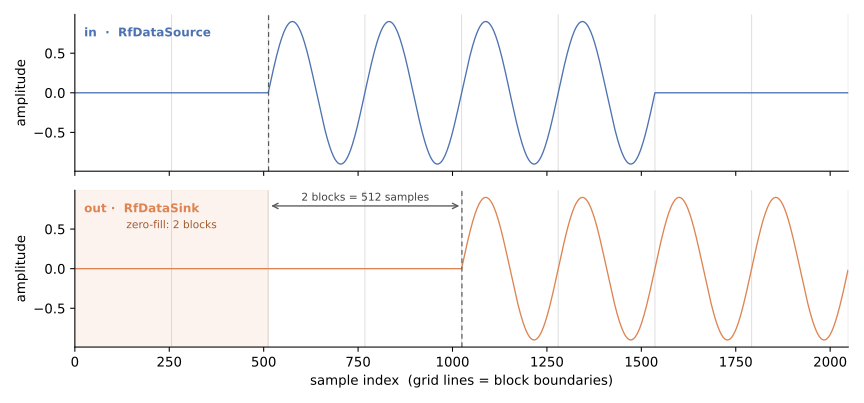
Two panels rather than one overlay, because an overlay occludes: the output drawn over the input hides the input wherever they coincide. Stacked, the delay is legible and neither trace is lost.
Three things to read off it, each measured by the script that drew it:
- the output is the input, bit-identical, not merely close;
- the shift is 2 whole blocks — 512 samples at
blksize=256— which isloop_blk_latency = 1 + dut.blk_latency; - the leading two blocks are flat, which is the DAC’s zero-fill before any samples reach it.
The second term of that latency is the ADC’s own hop, and it is the one that surprises: a converter
cannot emit samples it has not collected, so a block exists at its grid tick and is transmitted
across the following period. That hop was invisible while the ADC’s burst was charged at the fabric
clock rather than at samp_rate / samp_per_word, and appeared the moment it was paced honestly. It
is the same quantity the fidelity contract states as no dependency
shorter than 2 × blksize — one block per converter hop.
6. The deliberate faults
Why claim 2 is not redundant
Because claim 1 passes without it. Both failures below are silent: a starved grid emits well-formed zero blocks and a stalled consumer simply sees fewer of them, and every functional check downstream still passes on the data that did arrive.
So the counters are driven off zero deliberately, against predicted values — a counter that has never counted is not evidence that it works.
A late producer underruns
The source starts 2.5 block periods late, so periods 1 and 2 have nothing to send:
sim.tb.source.start_delay = 2.5 * sim.tb.blk_period
adc_if.underrun == 2 — exactly the two missed periods. What that looks like at the far end of the
loopback is two extra flat blocks:
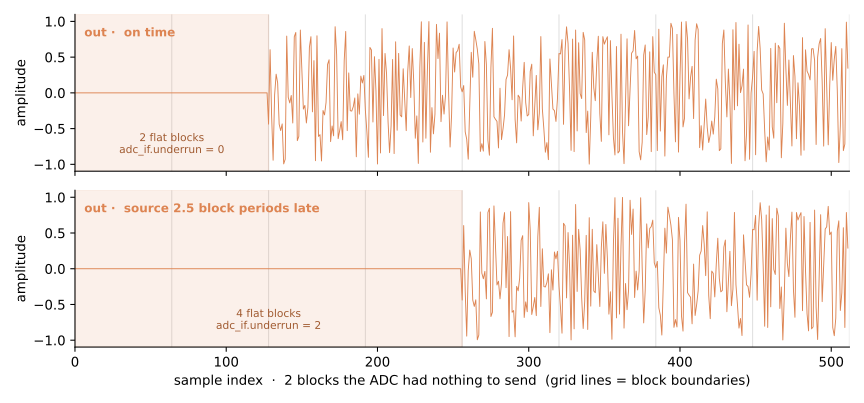
Both panels are the sink’s capture, and both use the on-grid waveform rather than the sine — every one of its blocks is full-scale, so a flat block at the sink can only be zero-fill.
| run | leading flat blocks at the sink | adc_if.underrun |
|---|---|---|
| on time | 2 | 0 |
| source 2.5 block periods late | 4 | 2 |
On time, the capture opens with the structural blocks the loop costs. Late, it opens with those plus the two periods the ADC zero-filled — and real data then resumes with the source’s first block. Nothing was reordered or lost; the grid simply ran while the producer was not ready.
That is the case for the picture. underrun == 2 is a number you have to trust; four flat blocks
where there were two is a thing you can count.
A stalled consumer overruns
The sink takes one block and then stops consuming forever. Its queue holds depth more, and
everything after that is dropped:
RfLoopbackSim(n_src_blk=8, sink_stall_after=1, sink_depth=2)
dac_if.overrun == 5 — that is 8 − 1 − 2: eight blocks emitted, one consumed, two queued. At
sink_depth=4 it is 8 − 1 − 4 = 3, so the count is a model of the buffer rather than a constant
that happened to match once. blocks_sent == blocks_delivered + overrun holds throughout, and the
grid indices the sink did receive show the gap.
Next
- Taking it to RTL — csynth, the XSI run, and the cycle gate.
Source of truth: examples/rf_loopback/rf_loopback.py,
examples/rf_loopback/rf_loopback_figures.py, tests/examples/test_rf_loopback.py.