Hardware modules
Both flows start from the same object — a HwModule. This page is the shared foundation: what a
module is, the three things that define it, and the taxonomy of kinds that sorts each module into
its flow.
From SimObj to HwModule
Everything in a Waveflow design is a SimObj — anything the simulation schedules,
with the three-phase lifecycle (pre_sim → run_proc → post_sim) and its own concurrent process(es).
Hosts, drivers, sinks, and testbenches are all SimObjs, and so is every piece of hardware.
A HwModule is a SimObj with structure that represents
hardware. On top of a SimObj it adds two things:
- Connectable structure — typed endpoints (the ports it talks to the outside world through) and
optional sub-components wired together by internal interfaces. It is the connectable node in
the design graph (
add_endpoint/add_comp/add_if). - A synthesis surface —
HwParamtemplate parameters and a codegen identity (cpp_kernel_name). That is what makes it the single source of truth for a hardware block: the same class is both the model you simulate and the source for a generated C++ kernel.
(A HwModule can be a single leaf or, following SystemC, the hierarchical top that contains many
sub-modules — the same class serves both, which is why “module” rather than “component” is the honest
name.)
A module is defined by three things
- Its interface endpoints — the typed ports it talks to the outside world through (a stream input, a memory-mapped master, an AXI-Lite register map). You declare them on the class.
- How it is wired — a module does not call other modules directly; its endpoints are bound to interfaces, which carry transactions to the endpoints of other modules.
- What it does — its behavior is the methods on those endpoints (
getan incoming transaction,writean outgoing one), driven from its lifecycle methods.
A minimal example — a moving-average filter, y[n] = ½·(x[n-1] + x[n]), streaming fixed-size blocks
of Float32:
@dataclass
class MovingAvg(HwModule):
    cpp_kernel_name: ClassVar[str | None] = "moving_avg"

    def __post_init__(self) -> None:
        super().__post_init__()
        self.x_in  = StreamIFSlave( name=f"{self.name}_x_in",  sim=self.sim, bitwidth=32)
        self.y_out = StreamIFMaster(name=f"{self.name}_y_out", sim=self.sim, bitwidth=32)
        self.add_endpoint(self.x_in)                       # <- endpoints
        self.add_endpoint(self.y_out)

    def run_proc(self) -> ProcessGen[None]:                # <- behavior
        xprev = 0.0
        while True:
            x = yield from self.x_in.get_schema(Samples)          # one block in
            xv = x.val
            y = 0.5 * (np.concatenate(([xprev], xv[:-1])) + xv)
            xprev = xv[-1]
            yield from self.y_out.write(Samples(y))        # one block out
Two endpoints declared in __post_init__; the behavior a loop over them in run_proc. The wiring
is not on the module — it is bound externally, by connecting x_in / y_out to
interfaces at the point the module is instantiated.
The kinds — and the flow each maps to
MovingAvg above is a plain HwModule: it simulates, but its run_proc computes with NumPy, so
it is a simulation-only model, not shaped for hardware generation. To make a module
synthesizable you subclass one of the execution-model kinds — each has a specialized process shape
that maps cleanly to a hardware pattern — and its compute moves into an
@synthesizable method in the array-operator idiom.
HwModule              base — a plain HwModule is a simulation-only model (MovingAvg above)
├── HostActivated        host-launched: implement on_start; runs once per trigger      -> sequential flow
└── FreeRunMod          free-running: implement run_iter (a leaf), OR add sub-components (a composite)
                                                                                        -> concurrent flow
There are exactly two synthesizable kinds, and each is the entry point to one flow:
- Plain
HwModule— a behavioral model of hardware Waveflow does not generate (a data converter, a memory, an RF channel). It never leaves simulation. HostActivated— the host launches it over a register map; writingap_startruns itson_startonce (read inputs, compute, write outputs, return). Use it for invocation-style accelerators. This is the sequential flow.FreeRunMod— a free-running module, in one of two shapes. A standalone one implementsrun_iter(one firing; the base loops it forever) and lowers to a singlehls::task; a composite has no body of its own — it wires sub-components, and each becomes its ownhls::task. A standalone module is just the 1-task case of a composite, so they are literally one class — there is no separate composite type; the top level of a design or a testbench is aFreeRunModtoo. This is the concurrent flow.
Which lifecycle method you implement is what distinguishes the kinds:
on_startfor a host-launched module,run_iterfor a standalone free-running one, and neither for a composite (its sub-components do the work). The kind is decided by content — arun_iterbody vs sub-components — so codegen dispatches on it directly rather than inferring the execution model from the shape of the code.
Kind is not the only axis
The kinds above answer one question: how is this module’s body invoked? That is a class fact — host-launched or free-running — and no build changes it.
There are two more axes, and keeping them apart is what lets one module serve more than one design.
| axis | question | decided by |
|---|---|---|
| kind | how is the body invoked? | the class (HostActivated / FreeRunMod) |
| hooks | is there a pre-written artifact for it? | the module, by declaring one |
| cut | which artifact applies? | the build |
Hooks: the three pre-written realizations
A module’s artifact is either derived from its Python or handed over ready-made. Handing it over is a hook, and there are three — all optional:
| hook | declares | realized as |
|---|---|---|
kernel_task() |
“my hls::task body is X” |
a task inside the generated top |
rtl_module() |
“my Verilog is Z” | an RTL module beside the generated top |
bfm_model() |
“my cycle model is Y” | an XsiSimObj beside the top |
| none | nothing — there is no pre-written artifact | nothing is emitted: a pysim-only node |
A module may declare any, all, or none. None is not an error — it is a plain HwModule
that never leaves simulation, and that is a finding from check, not something the class states
about itself. (Overriding is the declaration: the base bfm_model() raises, and declares_hook()
detects the override by identity, exactly as _kind() detects a run_iter override.)
The third row is easy to read past, so it is worth naming a real one. The canonical pysim-only nodes
are the RF environment participants — RfDataSource and RfDataSink, and today the
Rfdc converter with them:
>>> check(RfDataSource, "xsi_bfm_model")
(False, 'RfDataSource declares no bfm_model() hook, so it has no pre-written cycle model ...')
>>> potential_targets(RfDataSource)
frozenset()
They exist in the Python graph and nowhere else, and asking check is how you find that out. Note
this is a statement about today’s build, not about the class: a module acquires a hook when
somebody writes one, and nothing else about it changes.
Note what a hook is not: it is not a kind. MemRStream hands over an entirely hand-written
hls::task body and lives inside a synthesized kernel; StreamDriver hands over an entirely
hand-written cycle model and lives outside one. Extracted-vs-pre-written
(comp_codegen vs custom_hooks) is a real axis, and it is
not this one.
The cut is a build choice, not a class fact
Consider a design of three modules. In one synthesis the DUT is mod1 alone and mod2/mod3 are
testbench models; in another all three are inside the DUT. Nothing about mod2 changed — only
where the boundary was drawn.
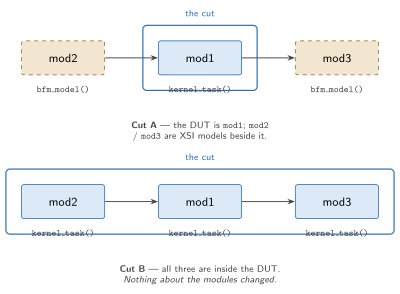
So no module declares which side it is on, and the framework does not either:
- The boundary is derived. A child endpoint not bound to one of the composite’s internal
interfaces is a boundary port. Only the external port names are declared, and only because
local names collide (two children both call their memory port
m_mem). - The cut is an argument.
tb_top_spec(tb, dut=...)names which child is synthesized; discovery is the default, not the mechanism. - The cut decides which hook is consulted — inside the top,
kernel_task(); beside it in the same design,rtl_module(); outside the design,bfm_model().
This is why “is this a DUT or a testbench participant?” is not a property you will find on any class.
Asking it of a (module, cut) pair is what check(mod, target) is for. See
Concurrent flow — the DUT/TB boundary for what re-cutting
costs in practice, which as of today is more than it should.
Next
Pick the kind your design is, and follow its flow:
- Sequential (host-activated) — a
HostActivatedmodule and a sequential Vitis testbench, verified in C-sim and co-sim. - Concurrent (free-running) — a
FreeRunMod(standalone or composite), verified at RTL through an XSI BFM.
Source of truth: waveflow/hw/hw_module.py (HwModule), waveflow/hw/hw_hostactivated.py
(HostActivated), waveflow/hw/hw_freerun.py (FreeRunMod — standalone or composite).